

 About Us
 Why K12?
 Safety Needs
 How Students Succeed
 FAQs
FAQs Online Elementary School
 Online Middle School
 Career and College Prep
 Online High School
 Student Clubs
 Career and College Services
 Inside the Online Classroom
 A Day in the Life
 Social & Extracurricular
 Advice, Tips & Inspiration
 Benefits for Life
 Enroll
 All School Options
 Need More Help?
What is ESY (Extended School Year)? Understanding Special Education Summer Services
Learn how extended school year (ESY) services help students with IEPs maintain progress during school breaks, who qualifies, and how summer support works.

Table of Contents
Extended School Year (ESY) services are special education services provided during school breaks to help students with disabilities maintain important skills. ESY is included in a student’s individualized education plan (IEP) when the IEP team determines that long breaks could lead to significant skill loss or regression.
ESY is not an optional summer school or summer camp. Unlike these programs, ESY is a legally required service under the Individuals with Disabilities Education Act (IDEA) for eligible students who need continued support to receive a Free and Appropriate Public Education (FAPE). While summer school generally serves any student for enrichment or remediation, ESY is specialized for those who need to maintain skills during extended breaks.
If your child has an IEP, you may wonder whether they need continued support during summer break. Understanding how ESY works can help you make informed decisions about your child’s learning, available services, and summer planning.
ESY Is a Legal Right Under IDEA (Not Optional Summer School)
ESY services are mandated by the Individuals with Disabilities Education Act (IDEA). Under IDEA, schools must provide Free Appropriate Public Education (FAPE) to all eligible students with disabilities. FAPE means special education and related services provided at public expense, without charge to families, and designed to meet each child’s unique needs.
ESY is fundamentally different from traditional summer school. Summer school is typically an optional enrichment or remedial program available to any student. ESY is an individualized continuation of special education services required when a child would lose critical skills during summer break. According to official IDEA regulations, ESY must be provided at no cost when the IEP team determines these services are necessary for FAPE.
The key distinction is legal requirement. ESY is not a choice — it’s a right for eligible students.
Who qualifies for ESY services?
ESY eligibility is determined individually by your child’s IEP team, which includes you as an equal member. No single factor determines eligibility — the team considers multiple criteria.
Regression and recoupment are the most common criteria. Regression means skill loss during breaks from school. Recoupment is the time it takes for your child to regain lost skills. If your child experiences significant regression and requires excessive time to recoup skills, ESY may be necessary.
Other factors IEP teams consider include:
- Level of support needed: Students with more significant support needs may require continued services during school breaks.
- Emerging skills: If your child is on the verge of a breakthrough — like learning to read or communicate — interruption could cause loss of critical progress.
- Self-sufficiency skills: Skills that increase independence may require continuous attention.
- Interfering behaviors: Behavioral challenges that would worsen without consistent support.
You are an equal IEP team member with the right to participate in all ESY discussions and decisions. If you believe your child needs ESY services, you can request an IEP meeting specifically to discuss eligibility. The qualification process involves reviewing documentation and considering your child’s individual needs.
What services does ESY provide?
ESY provides the same special education and related services your child receives during the school year, tailored to prevent skill regression. Services are individualized based on your child’s IEP goals.
Common ESY services include:
- Specialized instruction: Individualized teaching designed to address your child’s unique learning needs
- Speech-language therapy: Services to maintain communication skills
- Occupational therapy (OT): Support for fine motor skills and daily living activities
- Physical therapy (PT): Services addressing mobility and gross motor development
- Behavioral support: Positive behavioral interventions and strategies
ESY services must be provided in the least restrictive environment (LRE) appropriate for your child. This might mean a general education summer program with support, a specialized classroom, community-based settings, or even virtual instruction. The focus is maintenance — keeping skills intact — rather than introducing new curriculum.
How ESY Differs From Other Summer Programs
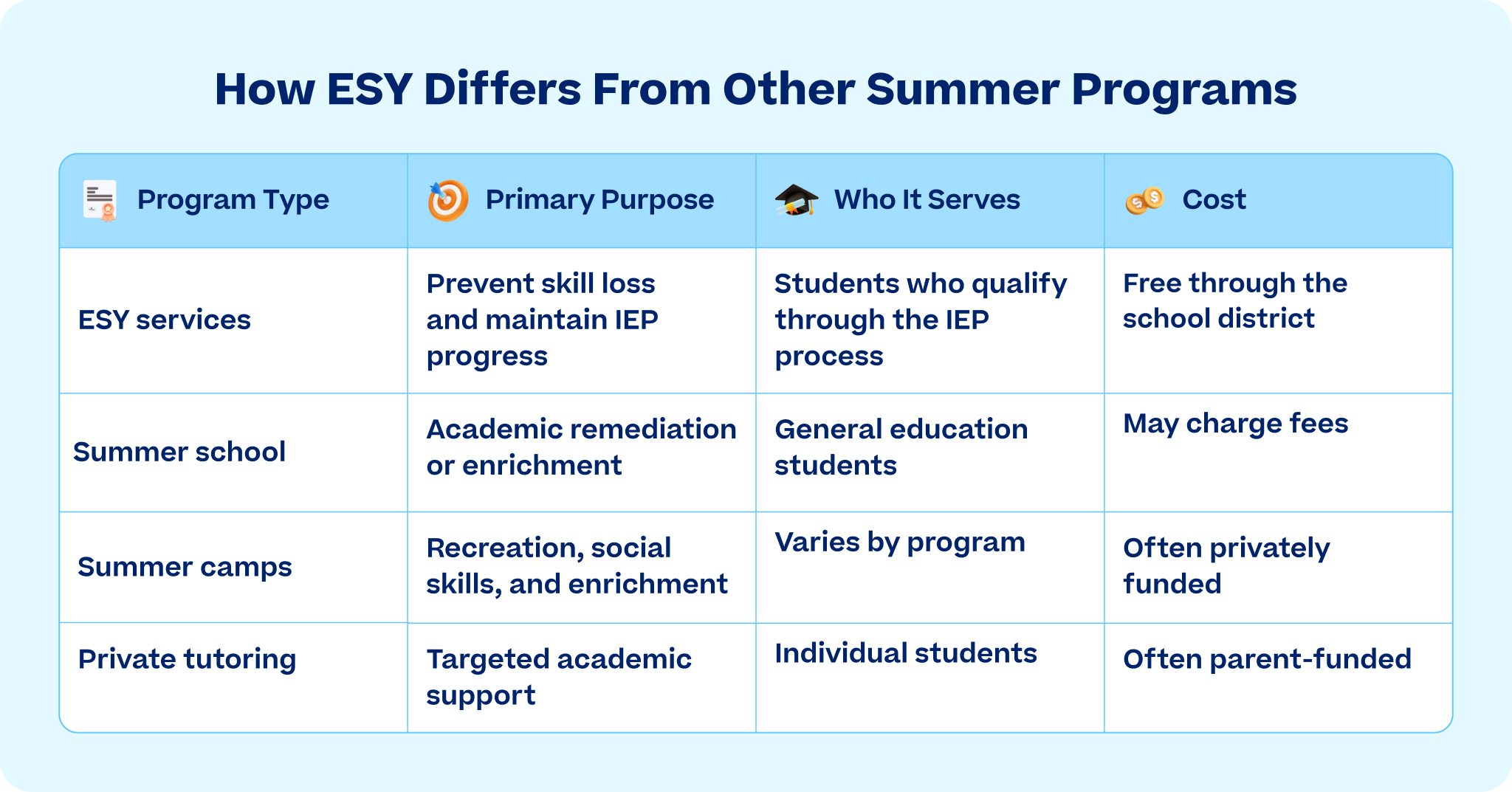
Some families combine ESY with camps or other summer programs to support both academic progress and social development.
Families deciding between different summer support options may benefit from comparing ESY services and traditional summer camps. If you are concerned about cost, it may be helpful to also explore different ways to pay for special education summer programs.
How to Access ESY Services for Your Child
ESY eligibility should be discussed at every IEP meeting, typically annually. If ESY isn’t mentioned, you can request a meeting specifically to discuss it.
The IEP team reviews documentation, including progress monitoring data, teacher observations, and evidence of past regression after breaks. You can provide input about what you’ve observed at home during previous summer breaks.
If the team determines your child is eligible, ESY services are written into the IEP at no cost to you. If ESY is denied and you disagree, you have the right to request mediation or a due process hearing. Understanding your options for special education summer programming — including both free ESY services and other program types — helps you plan effectively for your child’s summer learning needs.
Supporting Your Child’s Summer Learning Journey
ESY services ensure your child doesn’t lose meaningful progress during summer break. As a legal entitlement under IDEA, ESY provides the continuity some students need to maintain critical skills and continue making meaningful educational progress.
You know your child best. If you’ve noticed significant skill loss after previous breaks, or if your child is at a breakthrough moment in learning, bring these observations to the IEP team. Your voice matters in determining whether ESY is necessary for your child to receive FAPE.
Whether your child receives ESY services, attends a specialized camp, or enjoys a combination of structured learning and summer fun, the goal is the same — supporting continued growth and protecting the progress your child has worked so hard to achieve.
Looking for learning environments that support students with IEPs beyond the summer months? Explore how K12-powered schools provide individualized special education support and flexible learning options for students with diverse needs.
Common Questions Parents Ask About ESY
Is ESY required for all students with IEPs?
No, ESY is determined individually. Not every student with an IEP needs ESY. Only those who would experience significant regression without summer services.
Can ESY be provided online?
Yes, if the IEP team determines virtual delivery is appropriate for your child’s needs. Virtual ESY must still provide the same educational benefit as in-person services.
Does ESY address social and emotional needs?
ESY focuses on maintaining IEP goals, which may include social emotional objectives. However, if your child needs additional peer interaction and community connection, many families explore social skills development opportunities through specialized summer programs as a complement to ESY.